Author native desktop interfaces in HTML/CSS.
KUI brings HTML/CSS interfaces, native application logic and built-in capabilities together for teams that want control over their desktop runtime, components and delivery.
- Modern web layout: Use familiar Flex, Grid, selectors, CSS variables, typography and animation. Canvas, SVG and DOM events have dedicated APIs, with individual support details in the reference.
- Lean runtime & Lua: KUI ships its own HTML/CSS renderer, without Chromium or a system WebView. Keep business logic in the native host, and use optional Lua for interface interactions.
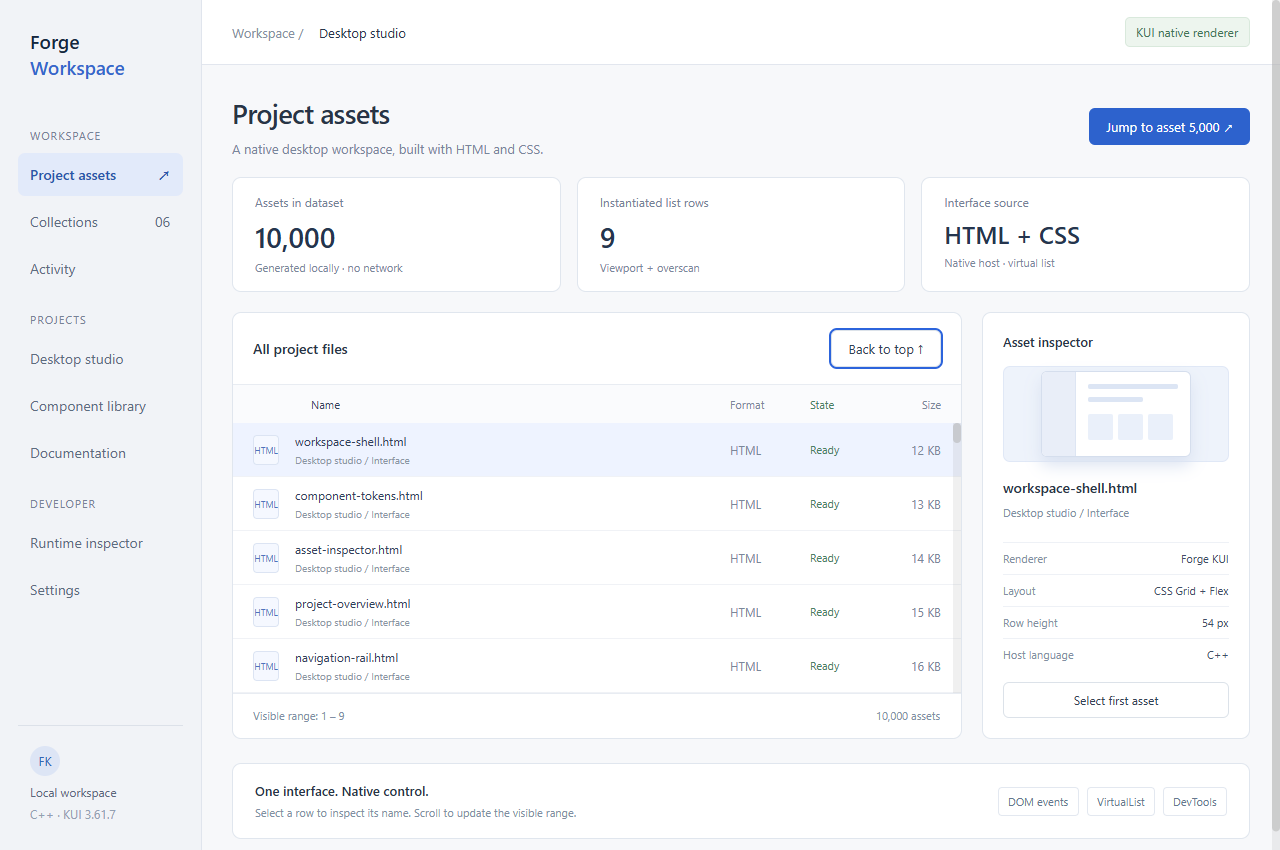
- Built-in virtual components: VirtualList, ListView and TreeView are built in. Instantiate rows for the viewport and overscan, with APIs for selection, tree expansion and dynamic data changes.
- An extensible native core: Add an editor, PDF viewer or 3D through standalone extensions. Register your own elements through a pure C ABI, with styling, events and a defined drawing lifecycle.
- Built for agent-assisted development: You do not need to learn KUI’s features first. Describe layout, style and actions using HTML/CSS web standards. Your agent can consult the SDK docs, handle integration and inspect the UI and interactions through DevTools/MCP.
.NET, XAML and custom rendering
Avalonia builds interfaces with XAML or .NET code and has its own rendering pipeline, with Skia as the default backend. Its controls, styles and data binding follow Avalonia contracts; CSS-inspired selectors do not establish browser CSS compatibility.
Connect a .NET business layer
This KUI site documents C++, C, Go and Rust integration without promising a ready-made .NET binding. Retaining .NET logic requires C ABI interop or process communication with explicit string, callback, memory and thread ownership. A P/Invoke declaration alone is not a complete binding.
Replace XAML and bindings
Rebuild the interface in HTML/CSS and map commands, validators and two-way binding to application state and DOM events. Check validation, asynchronous updates and cancellation on window closure before estimating the full migration.
Sources and practice
Technical models were checked against official documentation on 2026-11-09. Migration sections are our engineering guidance, without cross-framework benchmark results. Check KUI interfaces, limitations and examples for specific capabilities.
Something unclear?
Report an issue on this page →